
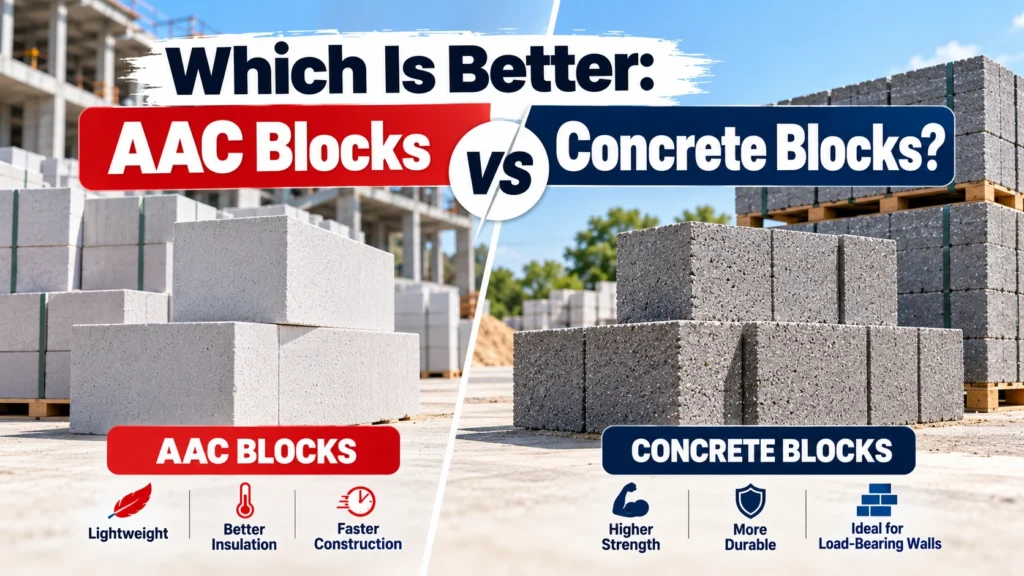
Which Is Better: AAC Blocks or Concrete Blocks?
Neither is better in every case. AAC suits lightweight, insulated, non-load-bearing walls in framed buildings, while concrete blocks suit load-bearing walls, compound walls, foundations and retaining structures. This guide compares the two on strength, cost, insulation and durability so you can match each block to the right wall.
Quick Verdict
Choose AAC for partition and infill walls where light weight and insulation matter. Choose concrete blocks for compound walls, basements, foundations and load-bearing or exposed walls. Many projects use both.
What Are Concrete Blocks and AAC Blocks?
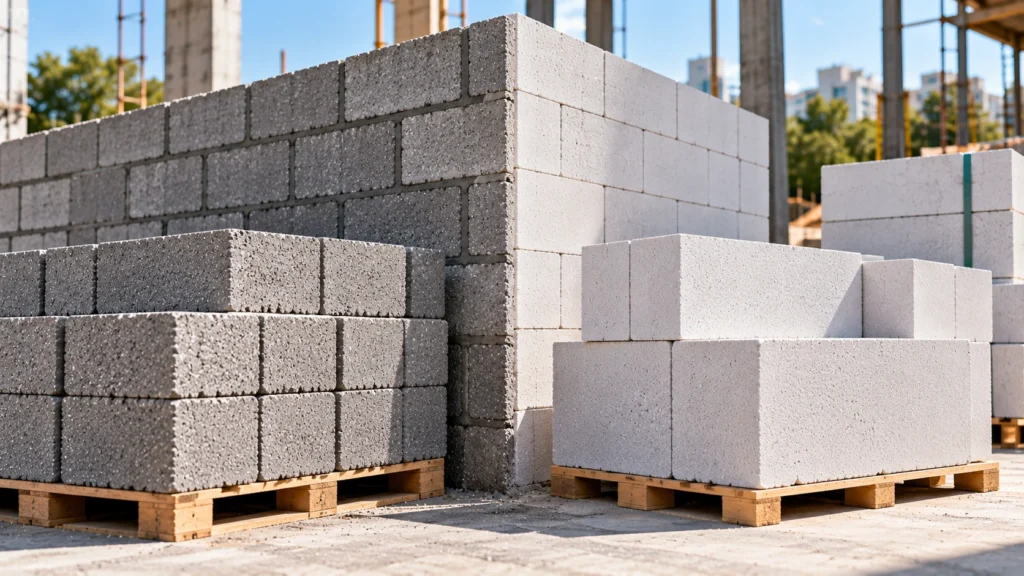
Concrete blocks, also used as concrete wall blocks, are precast units made from cement, aggregates and water, compacted and cured. They come as solid or hollow blocks, and solid concrete blocks are dense enough for load-bearing walls. AAC (autoclaved aerated concrete) blocks are made from cement, lime, fly ash or sand and a little aluminium powder that creates tiny air bubbles, then steam-cured in an autoclave, which makes them very light and porous.
AAC Blocks vs Concrete Blocks: Comparison
| Factor | AAC Blocks | Concrete Blocks |
|---|---|---|
| Weight | Very light, about 600 kg/m³ | Heavy, solid concrete blocks about 1,800 kg/m³ or more |
| Compressive strength | Typically 3 to 4.5 N/mm² | Typically 4 to 7.5 N/mm² or more, depending on compressed solid or aggregate-line type |
| Load-bearing use | Limited, mainly infill | Yes, with solid grades |
| Thermal insulation | Better | Moderate |
| Water absorption | Higher, needs waterproofing | Under about 10% in good blocks |
| Block size | 600 × 200 mm, fewer joints | 400 × 200 mm, more joints |
| Construction speed | Faster | Slower |
| Best for | Partition and infill walls | Compound walls, foundations, load-bearing walls |
Detailed Comparison
Strength and Load Capacity
Concrete blocks win. AAC works as infill where an RCC frame carries the load, but walls that support slabs, retain soil or take impact should use solid concrete blocks, always as per the engineer’s drawing.
Cost
The two are closer than per-piece prices suggest. A 600 × 200 mm AAC block covers about 1.29 sq ft, or roughly 0.77 blocks per sq ft, while a 400 × 200 mm concrete block covers about 0.86 sq ft, or roughly 1.16 blocks per sq ft. At illustrative 6 inch prices of ₹60 for AAC and ₹42 for concrete, the blocks cost about ₹46 and ₹49 per sq ft of wall. AAC saves on mortar and plaster, while concrete blocks are the cheapest sound option where AAC cannot be used at all.
Insulation, Water and Durability
AAC insulates better against heat, which helps on west-facing and top-floor walls, while dense concrete blocks block more noise. AAC absorbs more water, so external walls need a good plaster and waterproof system, and AAC should never sit below plinth level. Solid concrete blocks perform better in the monsoon on compound walls and parapets.
Speed and Finishing
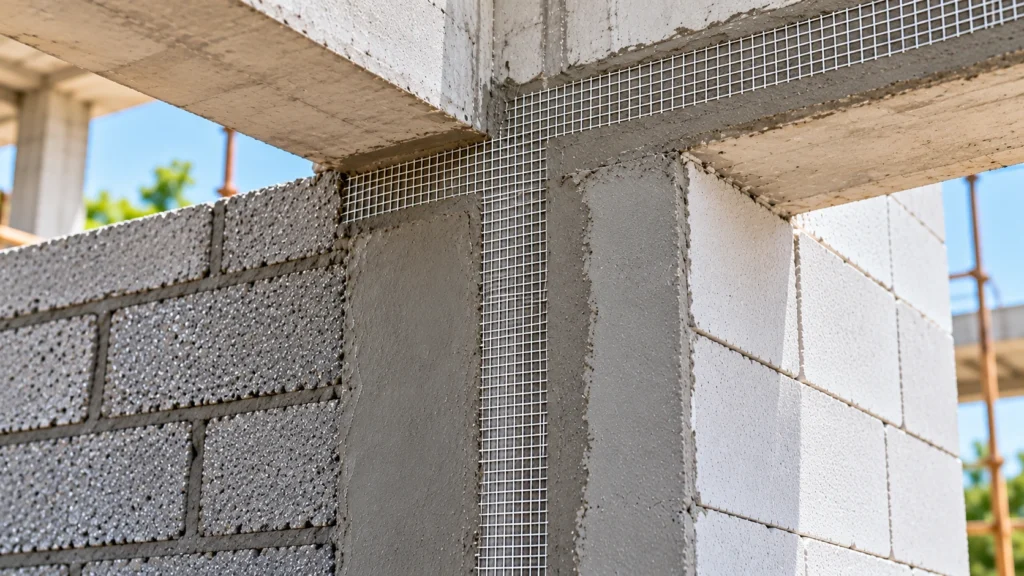
Larger, lighter AAC blocks lay faster and can be cut easily, but heavy fixtures need special fasteners and junctions need mesh to avoid cracks. Concrete blocks are slower but familiar to every mason, hold fixtures with ordinary plugs and take standard plaster.
Which Block Should You Choose?
| Project type | Recommended block |
|---|---|
| Independent house | Concrete blocks below plinth and for external load-bearing walls, AAC for internal partitions |
| Apartment | AAC for infill and partitions |
| Warehouse | Concrete blocks |
| Compound wall or basement | Solid concrete blocks |
Why Choose SDM Concrete?
SDM Concrete manufactures solid concrete blocks, hollow concrete blocks, paver blocks and kerb stones, and does not make AAC. That is why we say plainly that AAC suits many infill walls, and recommend concrete blocks for compound walls, foundations and load-bearing work. We are ISO certified, test blocks in our in-house quality lab with third-party reports, and deliver across North, South, East and Central Bangalore. See our SDM Concrete page, our ready mix concrete guide and our construction services.
Frequently Asked Questions
Which is better, concrete blocks or AAC blocks?
Concrete blocks for load-bearing, compound and exposed walls, AAC for lightweight infill in framed buildings.
Are AAC blocks stronger than concrete blocks?
No. AAC reaches about 3 to 4.5 N/mm², while solid concrete blocks reach 4 to 7.5 N/mm² or more.
Is AAC cheaper than concrete?
Per piece it usually costs more, but cost per square foot of wall is often similar.
Can AAC blocks be used for load-bearing walls?
Only in limited low-rise cases within the engineer’s design. Solid concrete blocks are preferred.
Which block is better for Bangalore's climate?
Both work if detailed well. AAC suits warm upper-floor walls, and concrete blocks suit walls exposed to the monsoon.
Are concrete blocks good for house construction?
Yes, solid concrete blocks are widely used for external and load-bearing walls.
Why do AAC blocks crack?
Usually from shrinkage, thick joints, missing mesh at beam junctions or poor plaster preparation.
How do I find concrete block suppliers near me?
Choose manufacturers with a visible plant, test reports and delivery to your area. SDM Concrete supplies across North, South, East and Central Bangalore.
Do AAC blocks need waterproofing?
Yes, external AAC walls need good plaster and waterproofing, and AAC should not be used below plinth.
Can I use AAC and concrete blocks in the same building?
Yes. Concrete blocks below plinth and on exposed walls, with AAC above for infill, is common.
Not sure whether to use AAC or concrete blocks?
See how they compare on strength, cost, insulation and durability and which suits your walls. Contact us for more!