Concrete Blocks vs Red Bricks in Bangalore: Cost, Strength and Durability Compared
More builders across Bangalore are weighing concrete blocks against red bricks before finalising their wall material, and the decision is no longer a straightforward one. Both materials have genuine strengths, and the right answer depends on where in your building the wall sits and what you are optimising for.
Quick answer: Concrete blocks generally cost less per square foot of finished wall, offer higher compressive strength (4 to 7.5 N/mm² versus 3.5 to 5.0 N/mm² for red bricks), and build faster. Red bricks retain a slight edge in thermal buffering and remain viable for smaller, budget-conscious builds. For most structural walls in Bangalore in 2026, concrete blocks are the better overall choice.
This guide compares concrete blocks vs red bricks on cost, strength, and durability specifically for Bangalore’s construction conditions and climate, so you can make the right call for your project.
What Is the Difference Between a Concrete Block and a Brick?
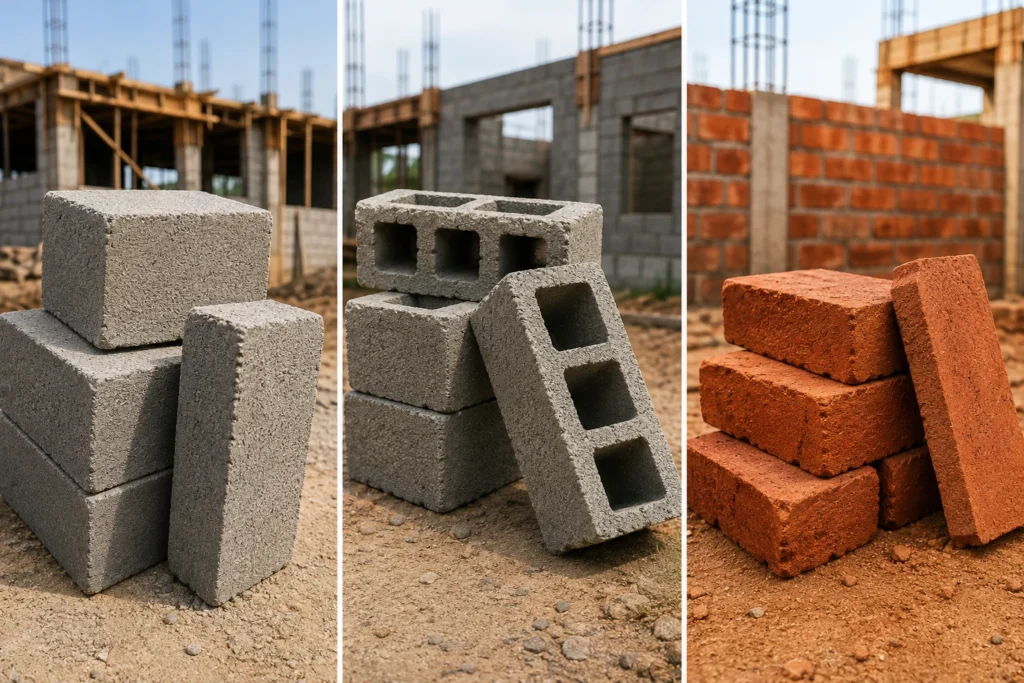
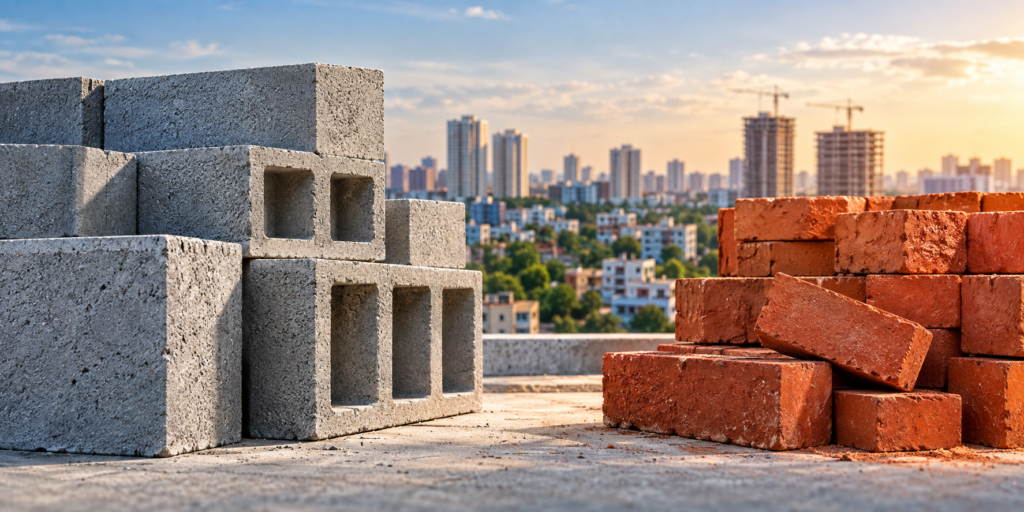
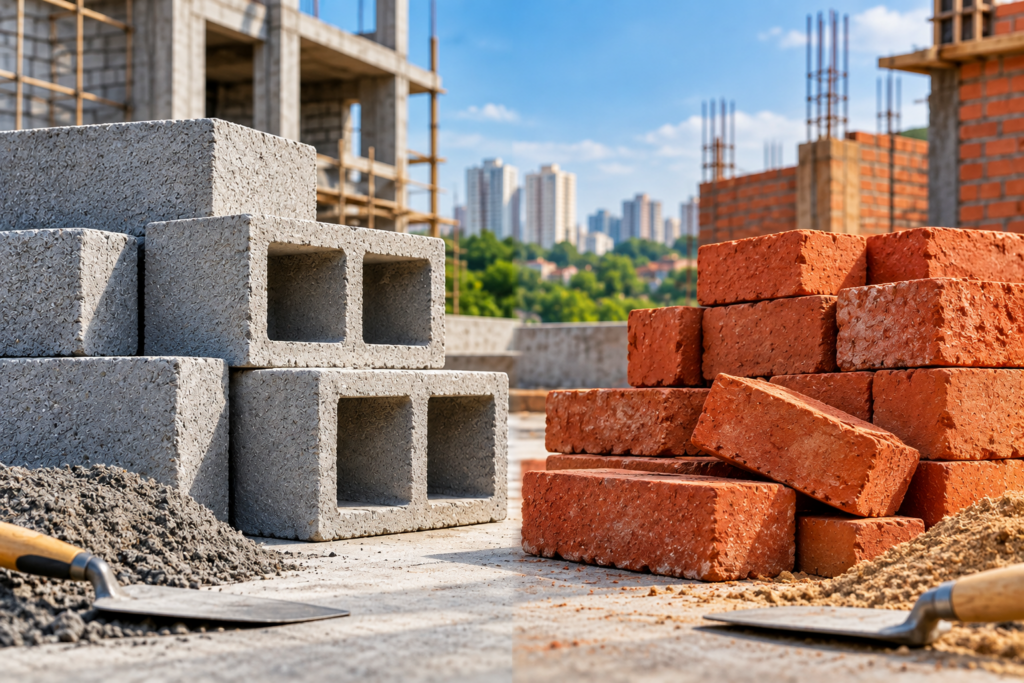
A concrete block is a precast masonry unit made from cement, aggregate, and water, cast in a mould and either hydraulic-pressed or vibrated to shape. A red brick is made from natural clay, moulded, dried, and fired in a kiln at high temperature. The manufacturing processes are entirely different, and this difference shows up directly in the final properties of each material.
Concrete blocks are produced in a controlled factory environment where cement content, aggregate ratio, and curing time can be measured and repeated consistently across every batch. Red bricks depend on the quality of the clay source and the firing process at each kiln, which means strength and dimensional accuracy vary considerably from one supplier to another and even within the same batch.
| Comparison | Concrete Blocks | Red Bricks |
|---|---|---|
| Compressive Strength | 4.0 to 7.5 N/mm² | 3.5 to 5.0 N/mm² |
| Price per Unit (2026) | Rs. 28 to Rs. 60 | Rs. 7 to Rs. 15 |
| Units per Sqft of Wall | 1.5 to 1.8 | 11 to 12 |
| Water Absorption | Below 10% | 15% to 20% |
| Construction Speed | Fast | Slower |
| Best Suited For | Load-bearing, multi-storey | Single-storey, traditional builds |
Comparing prices at face value is misleading because a concrete block covers considerably more wall area than a single brick. A fair cost comparison has to look at price per square foot of finished wall, not price per unit.
Concrete Block Price in Bangalore
Solid concrete blocks in Bangalore are priced between Rs. 28 and Rs. 60 per piece depending on size, with 6 inch blocks (the most commonly used size for internal load-bearing walls) typically ranging from Rs. 36 to Rs. 48. Hollow blocks are generally cheaper, in the Rs. 28 to Rs. 45 range.
Red Brick Price in Bangalore
Red bricks in Bangalore and across Karnataka are priced considerably lower per piece, typically between Rs. 7 and Rs. 15 depending on quality grade. First class bricks with good firing and minimal cracking sit at the higher end of this range.
Cost per Square Foot of Wall
A square foot of 6 inch block wall requires roughly 1.5 to 1.8 blocks. The same square foot of an equivalent brick wall requires 11 to 12 bricks. Once material, mortar, labour, and plastering are added together, the total cost per square foot narrows considerably between the two materials.
| Cost Component | Concrete Block Wall (per sqft) | Red Brick Wall (per sqft) |
|---|---|---|
| Material Cost | Rs. 60 to Rs. 86 | Rs. 80 to Rs. 165 |
| Labour Cost | Rs. 20 to Rs. 30 | Rs. 35 to Rs. 50 |
| Plastering | Rs. 15 to Rs. 20 | Rs. 18 to Rs. 25 |
| Total per Sqft | Rs. 95 to Rs. 136 | Rs. 133 to Rs. 240 |
The commonly held belief that bricks are cheaper does not hold up once the full wall cost is calculated. Concrete blocks typically work out equal to or cheaper than red bricks on a per square foot basis, largely because of lower labour and mortar consumption.
Compressive Strength Comparison
Concrete blocks manufactured to IS 2185 standards achieve compressive strengths ranging from 4.0 N/mm² for Grade D blocks to 7.5 N/mm² and above for Grade A blocks. Standard red clay bricks used in Karnataka typically achieve 3.5 to 5.0 N/mm², with considerable batch-to-batch variation depending on the kiln and firing quality.
Load-Bearing Capacity
Higher and more consistent compressive strength translates directly into greater load-bearing capacity. A concrete block wall can carry more load per unit area with a smaller safety margin required, because the material’s performance is predictable from batch to batch. Red brick walls, by contrast, need engineers to account for greater variability, which sometimes means thicker walls or more conservative design assumptions.
Which Is Better for Multi-Storey Construction
For ground-plus-two structures and above, concrete blocks are generally the safer and more efficient choice. Their higher and more consistent strength supports the loads from floors above without requiring oversized walls, and their dimensional consistency makes it easier for structural engineers to design with confidence.
| Building Type | Recommended Material | Reason |
|---|---|---|
| Single-storey Home | Either works well | Both meet load requirements comfortably |
| G+1 to G+2 | Concrete blocks preferred | Higher strength margin for upper floor loads |
| G+3 and above | Concrete blocks required | Consistent strength critical for structural safety |
Water Absorption and Moisture Resistance
Concrete blocks absorb less than 10% of their weight in water under IS 2185 specification. Red bricks typically absorb 15% to 20%, sometimes more with lower quality clay. This gap matters directly for Bangalore, where external walls face two distinct monsoon periods each year.
Weather Resistance in Bangalore's Climate
Bangalore receives close to 900 to 1,000mm of annual rainfall spread across the southwest and northeast monsoons. Walls with higher water absorption are more prone to dampness, efflorescence, and paint peeling on external faces. Concrete block walls generally stay drier and require less frequent repainting and maintenance as a result.
Lifespan Expectations
Both materials, when properly constructed and maintained, can last 50 years or more. Concrete block walls tend to show fewer moisture-related issues over that period given Bangalore’s climate, while well-fired red brick walls have a long track record of durability in drier conditions. The deciding factor is often less about the raw material and more about construction quality and maintenance.
Thermal Insulation
Red bricks, being a natural clay product, offer marginally better thermal buffering in very hot, dry climates because of their material density and thermal mass. Concrete blocks perform adequately but do not have the same natural insulation edge unless combined with AAC block sections in specific applications.
Sound Insulation
Concrete blocks, being denser overall, generally provide better airborne sound insulation than an equivalent thickness of brick masonry, particularly relevant for homes near busy roads or in dense residential clusters.
Construction Speed and Labour Cost
A concrete block replaces roughly eight to ten bricks, which means walls go up considerably faster. For Bangalore projects where labour costs have risen steadily over recent years, this speed advantage translates into a meaningful reduction in total labour spend.
Environmental Impact and Sustainability
Brick kilns consume significant quantities of clay soil and firewood or coal for firing, contributing to topsoil loss and air pollution. Concrete blocks, particularly those incorporating fly ash, are generally considered the more sustainable option since they reuse an industrial byproduct rather than consuming virgin clay.
Concrete Blocks vs Red Bricks: Pros and Cons
Concrete Blocks
Advantages of Concrete Blocks
- Higher and more consistent compressive strength
- Lower water absorption, better suited to Bangalore's monsoon
- Faster construction, lower labour cost per square foot
- Better dimensional consistency, easier to plaster
- More sustainable when fly ash content is used
Disadvantages of Concrete Blocks
- Slightly higher per-unit price than bricks
- Marginally lower natural thermal buffering than clay
- Quality still depends on the manufacturer, so verification matters
Red Bricks
Advantages of Red Bricks
- Lower per-unit cost and widely available everywhere
- Long, proven track record in Indian construction
- Slightly better natural thermal buffering in hot, dry conditions
- Familiar to virtually every mason in the country
Disadvantages of Red Bricks
- Higher water absorption, more prone to dampness in Bangalore's climate
- More variation in strength and dimensions between suppliers
- Slower to lay, higher labour cost per square foot of wall
- Greater environmental impact from clay extraction and kiln firing
Which Should You Choose? A Decision Framework
Budget-conscious builders planning a single-storey home with a tight upfront budget can reasonably choose either material, though concrete blocks often work out similar or cheaper on a total wall cost basis once labour is included.
For high-rise or load-bearing structures above two floors, concrete blocks are the stronger and more predictable engineering choice, and most structural engineers in Bangalore will recommend them for this reason.
Eco-conscious builders should lean toward concrete blocks, particularly those with fly ash content, given the lower environmental footprint compared to clay brick kilns.
- Is your building more than two floors? If yes, choose concrete blocks.
- Is your site in a flood-prone or high-rainfall area of Bangalore? If yes, choose concrete blocks for lower water absorption.
- Is minimising environmental impact a priority? If yes, choose fly ash concrete blocks.
- Is your budget extremely tight and the structure single-storey? Either material can work, compare total wall cost quotes from your contractor.
Frequently Asked Questions
Our construction experts are here to guide you through every stage of your project, from planning and approvals to construction and final handover.
Which is cheaper, concrete blocks or red bricks in Bangalore?
Per unit, red bricks are cheaper. Per square foot of finished wall including labour and mortar, concrete blocks are often equal to or cheaper than red bricks, since fewer units and less labour are needed to cover the same wall area.
Are concrete blocks stronger than red bricks?
Yes. Concrete blocks typically achieve 4.0 to 7.5 N/mm² compressive strength compared to 3.5 to 5.0 N/mm² for standard red bricks, and are also more consistent from unit to unit.
Which is more durable in Bangalore's climate?
Concrete blocks generally perform better in Bangalore’s monsoon climate due to their lower water absorption rate, which reduces dampness, efflorescence, and paint damage on external walls.
Can concrete blocks be used for load-bearing walls?
Yes. Concrete blocks meeting IS 2185 Grade A standards are specifically designed and commonly used for load-bearing walls, including in multi-storey residential buildings.
What is the price of concrete blocks in Bangalore in 2026?
Solid concrete blocks in Bangalore range from Rs. 28 to Rs. 60 per piece depending on size, with 6 inch blocks (the most common size) priced between Rs. 36 and Rs. 48.
Which is better, bricks or concrete blocks?
For most modern construction in Bangalore, especially multi-storey buildings, concrete blocks offer better strength, durability, and construction speed. Red bricks remain a reasonable choice for smaller, traditional single-storey builds.
Which block is best for house construction?
For external and load-bearing walls, solid concrete blocks meeting IS 2185 Grade A standards are best. For internal non-structural partitions, hollow blocks are a practical and cost-effective choice.
What do concrete blocks and bricks cost per square foot?
Concrete block walls typically cost Rs. 95 to Rs. 136 per square foot including labour and plastering. Red brick walls typically cost Rs. 133 to Rs. 240 per square foot for the same finished result.
Is it better to build with blocks or bricks?
For most contemporary construction, blocks offer a better balance of strength, speed, and moisture resistance. Bricks remain viable for smaller, budget-conscious, single-storey projects.
Which is better for building in India, concrete blocks or bricks?
Concrete blocks are increasingly preferred across urban India, including Bangalore, for their strength, speed, and consistency. Bricks continue to be used widely in smaller towns and rural construction where cost and local availability are the primary drivers.
Not Sure Which Solid Concrete Block Manufacturers to Trust?
Get IS 2185-certified blocks straight from our facility, no middlemen, no compromised quality. Book a free site visit today.