
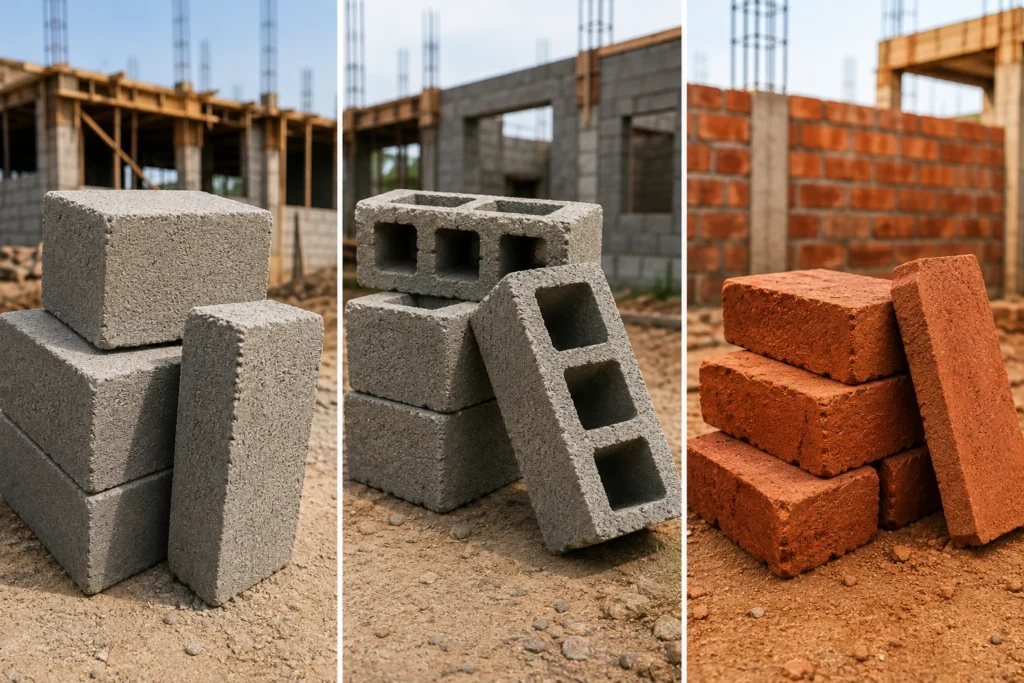
Solid Blocks, Hollow Blocks or Red Bricks: Which One for Which Wall?
Walk into any construction site in Bangalore and you will see three types of masonry material in use: solid concrete blocks, hollow concrete blocks, and red or fly ash bricks. The contractor on site almost always has a preference for one or the other, and that preference is not always based on engineering logic. Sometimes it is habit, sometimes it is what is cheapest to source that week, and sometimes it is simply what the labour team knows how to lay fastest.
The problem is that the three materials have genuinely different structural and practical characteristics, and those differences matter depending on where in your building the wall is going. Using the wrong material in the wrong place costs more over the life of the building, even if it saves money on the day you place the order.
This guide explains what each material offers, where each one belongs, and how the true cost per square foot of finished wall compares across all three.
At a Glance: The Three Materials Side by Side
| Property | Solid Concrete Blocks | Hollow Concrete Blocks | Red Clay Bricks | Fly Ash Bricks |
|---|---|---|---|---|
| Compressive Strength | 4.0 to 7.5 N/mm² | 2.0 to 5.0 N/mm² | 3.5 to 5.0 N/mm² | 3.5 to 7.5 N/mm² |
| Water Absorption | Below 10% | Medium | High (15% to 20%) | Medium |
| Wall Build Speed | Fastest | Fast | Slowest | Fast |
| Sound Insulation | Good | Lower | Moderate | Moderate |
| Best Wall Use | Load-bearing, compound, external | Internal partitions | Single-storey, budget | Single-storey, eco-friendly |
| 2026 Cost per Unit (Bangalore) | Rs. 36 to Rs. 60 | Rs. 28 to Rs. 45 | Rs. 7 to Rs. 12 | Rs. 6 to Rs. 10 |
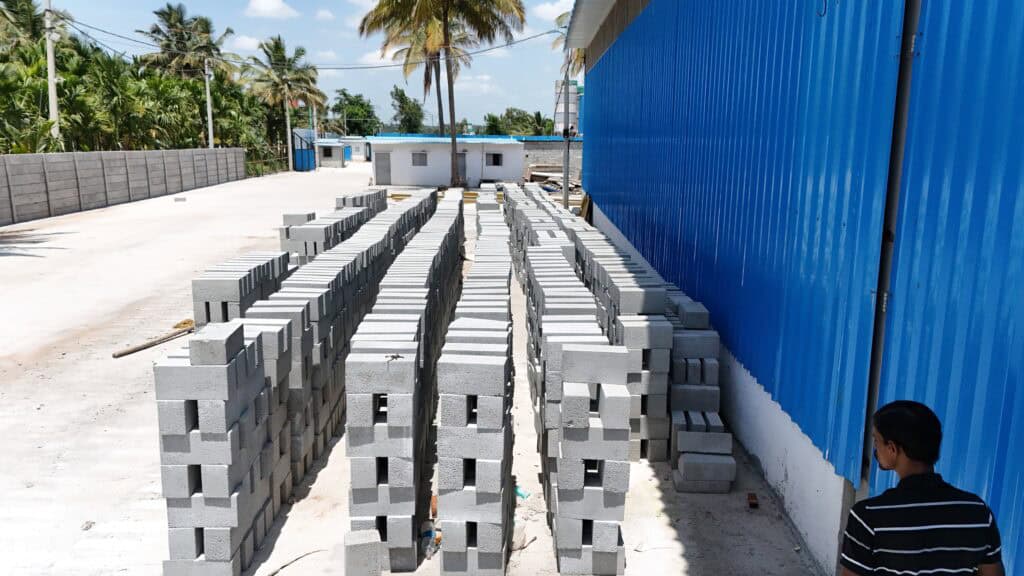
Solid concrete blocks, also known as solid cement concrete blocks or solid cement blocks, are the dominant choice for structural masonry in Bangalore residential construction and have been for at least a decade. Their defining property is density: unlike hollow blocks, they have no voids, which means more material per unit and correspondingly higher compressive strength.
A properly manufactured solid block meeting IS 2185 Grade A standards achieves a minimum average compressive strength of 7.5 N/mm². Standard red bricks from Karnataka typically achieve 3.5 to 5.0 N/mm². For a load-bearing external wall in a two or three storey house, that difference in structural capacity is meaningful.
Solid blocks are also more dimensionally consistent than hand-made bricks. Each block is pressed in a fixed mould, which means length, width, and height are consistent from unit to unit within a production batch. This dimensional regularity produces straighter walls, uniform mortar joints, and a surface that holds plaster better and with less material. The resulting plaster coat is typically 5 to 8mm thinner on solid block walls than on brick walls, which reduces plastering material consumption across a full house build.
The water absorption advantage is particularly relevant in Bangalore. Solid concrete blocks absorb less than 10% of their weight in water per IS 2185. Uncoated red bricks can absorb 15% to 20%. Lower absorption means external walls shed rainwater rather than drawing it in, which reduces the incidence of damp patches internally, efflorescence on external faces, and paint deterioration caused by moisture cycling through the wall material during Bangalore’s monsoon season.
Hollow Concrete Blocks: The Right Tool for Partitions
Hollow blocks are concrete blocks with one or more cavities running through their length. These voids reduce the net cross-sectional area available to carry compressive loads, which is why hollow blocks have lower compressive strength per unit than solid blocks of the same outer dimensions. They are also lighter per unit, which makes them easier to handle and reduces the structural load on the floor slab or beam they are built off.
The lighter weight and lower cost per unit (Rs. 28 to Rs. 45 versus Rs. 36 to Rs. 60 for solid) make hollow blocks an efficient choice for internal partition walls that carry no structural loads. In a multi-storey building, internal room dividers that simply separate spaces without bearing any slab weight above are a sensible application for hollow blocks. The weight saving reduces the total load on the building’s frame and the lower unit cost reduces masonry cost for the partition scope.
Hollow blocks are not appropriate for external load-bearing walls, compound walls, or any wall that carries a floor slab, a beam, or significant lateral loads from wind or earth pressure. In these applications, the hollow section’s reduced compressive capacity and the blocks’ higher sensitivity to moisture penetration through the cavities make solid blocks the clearly better engineering choice.
Red Bricks: Where They Still Belong
Red clay bricks have been used in construction across India for centuries. In Bangalore, they are increasingly relegated to specific applications where their characteristics suit the requirement rather than being used as a general-purpose wall material.
Red bricks from Karnataka’s brick kilns typically have compressive strength in the 3.5 to 5.0 N/mm² range for machine-made varieties, dropping lower for handmade units. Their water absorption of 15% to 20% by weight is notably higher than both solid blocks and hollow blocks, which matters for any wall exposed to Bangalore’s rainfall.
The genuine strength of red bricks is thermal buffering. The clay material’s heat storage capacity means brick walls heat up and cool down more slowly than concrete block walls of the same thickness, which can be beneficial for rooms exposed to intense afternoon sun without air conditioning. For single-storey residential buildings in more rural areas of Karnataka where construction budgets are tighter and the thermal benefit is valued, red bricks remain a practical choice.
In Bangalore’s urban and semi-urban zones, red brick use has declined substantially in structural applications. The speed disadvantage compared to blocks (a mason lays 500 to 600 bricks per day versus the equivalent of 1,200 to 1,500 bricks’ worth of wall area using 6 inch solid blocks) has become too significant a cost in a market where skilled mason day rates have risen considerably over the past five years.
Fly Ash Bricks: The Eco-Friendly Middle Ground
Fly ash bricks are manufactured from fly ash, a byproduct of coal thermal power plants, combined with cement, gypsum, and sand. They are lighter than red clay bricks, more dimensionally consistent, and classified as a green building material because they reuse industrial waste.
In terms of structural performance, fly ash bricks occupy a middle position. At their upper quality end, they approach the compressive strength of solid concrete blocks. At their lower quality end, particularly from smaller Bangalore-area manufacturers, they perform comparably to average red bricks. Moisture absorption is moderate and, like hollow blocks, they are better suited to applications where maximum structural load-bearing capacity is not required.
For single-storey residential construction in Bangalore where budget is the primary constraint and the build does not require the full structural capacity of solid blocks, fly ash bricks are a reasonable and eco-conscious choice. For multi-storey buildings, solid concrete blocks are the more reliable structural option.
Which Wall Needs Which Material?
This is the practical answer to the question in the article’s title. The table below shows the recommended material for each wall type based on structural requirements and practical performance in Bangalore’s construction and climate context.
| Wall Type | Recommended Material | Reason |
|---|---|---|
| Compound and boundary wall | Solid concrete blocks | Structural strength and low water absorption for permanent outdoor exposure |
| External load-bearing wall (all floors) | Solid concrete blocks | Compressive strength required for loads from slabs and beams above |
| Multi-storey building exterior (G+2 and above) | Solid concrete blocks | Load-bearing capacity and seismic resistance per Bangalore Zone II requirements |
| Internal non-load-bearing partition | Hollow blocks | Weight reduction, lower cost, adequate strength for space division only |
| Single-storey wall on a budget | Fly ash bricks or red bricks | Lower upfront material cost, adequate performance for single floor loads |
| Internal wall for thermal comfort | Hollow blocks or AAC blocks | Better insulation properties for internal rooms in hot climates |
True Cost Per Square Foot: A More Honest Comparison
Per-unit price is a misleading comparison because the three materials cover very different wall areas per piece. A fair cost comparison must look at the total cost per square foot of finished wall, including material, mortar, labour, and plastering.
| Solid Blocks (6 inch) | Hollow Blocks (6 inch) | Red Bricks (equivalent thickness) | |
|---|---|---|---|
| Units needed per sqft of wall | 1.5 to 1.8 blocks | 1.5 to 1.8 blocks | 11 to 12 bricks |
| Unit price in Bangalore (2026) | Rs. 36 to Rs. 48 | Rs. 28 to Rs. 40 | Rs. 7 to Rs. 12 |
| Material cost per sqft | Rs. 60 to Rs. 86 | Rs. 50 to Rs. 72 | Rs. 80 to Rs. 144 |
| Labour cost per sqft | Rs. 20 to Rs. 30 | Rs. 20 to Rs. 28 | Rs. 35 to Rs. 50 |
| Plastering cost per sqft | Rs. 15 to Rs. 20 | Rs. 18 to Rs. 25 | Rs. 18 to Rs. 25 |
| Total per sqft | Rs. 95 to Rs. 136 | Rs. 88 to Rs. 125 | Rs. 133 to Rs. 219 |
Common Myths About Wall Materials in Bangalore Construction
Myth: Solid blocks are always more expensive than bricks.
Per unit, yes. Per square foot of finished wall, no. The labour savings from faster laying and the reduced plastering thickness frequently offset most of the solid block material price premium.
Myth: Bricks have been used for generations so they must be better.
Longevity of use reflects historical availability, not superior structural performance. On compressive strength, water absorption, and dimensional consistency, modern solid concrete blocks outperform standard red bricks across every measurable parameter.
Myth: Hollow blocks are too weak to use in any structural application.
Hollow blocks can carry structural loads in appropriate applications. The issue is using them in applications where solid blocks are required, such as external load-bearing walls in multi-storey buildings, not hollow blocks in general. For single-storey internal partitions, they are entirely adequate.
Myth: Traditional materials are inherently more durable.
Durability comes from material properties relevant to the application, not from tradition. A solid concrete block wall with proper plastering and waterproofing will outperform an unprotected brick wall on every durability measure over a 30 to 50 year building life in Bangalore’s climate.
Frequently Asked Questions
Our construction experts are here to guide you through every stage of your project, from planning and approvals to construction and final handover.
Are solid concrete blocks better than red bricks?
For most structural applications including external walls, load-bearing walls, and compound walls, solid concrete blocks outperform red bricks on compressive strength, water resistance, and construction speed. Red bricks are a viable lower-cost option for single-storey or non-structural work.
What is the standard size of hollow blocks?
Standard hollow blocks in Bangalore follow IS 2185 Part 2 dimensions. The most common sizes are 400 x 200 x 200 mm (16 x 8 x 8 inches) and 400 x 200 x 150 mm (16 x 8 x 6 inches).
Which is better, hollow blocks or bricks?
Hollow blocks are faster to lay, more dimensionally consistent, and lighter than bricks. For internal partition walls in modern construction, hollow blocks are generally preferred. For any structural or external wall application, solid blocks are the better choice over both.
Which is cheaper, solid blocks or hollow blocks?
Hollow blocks are cheaper per piece. However, when total wall cost per square foot is calculated including labour and plastering, the difference is considerably smaller than the unit price suggests.
Can solid blocks be used for a two-storey house?
Yes. Solid concrete blocks meeting IS 2185 Grade A standards are entirely appropriate for external load-bearing walls in two and three storey residential buildings in Bangalore.
Do solid blocks need plastering?
Yes. Solid block walls are plastered for weather protection and surface finish, just as brick walls are. The plaster coat on solid block surfaces is typically thinner because the block face is denser and provides better key for plaster adhesion.
Not Sure Which Blocks Your Walls Actually Need?
Skip the guesswork on solid blocks, hollow blocks, or bricks. We’ll recommend the right blocks for each wall. Book a free site visit and get a concrete blocks price estimate within 48 hours.