
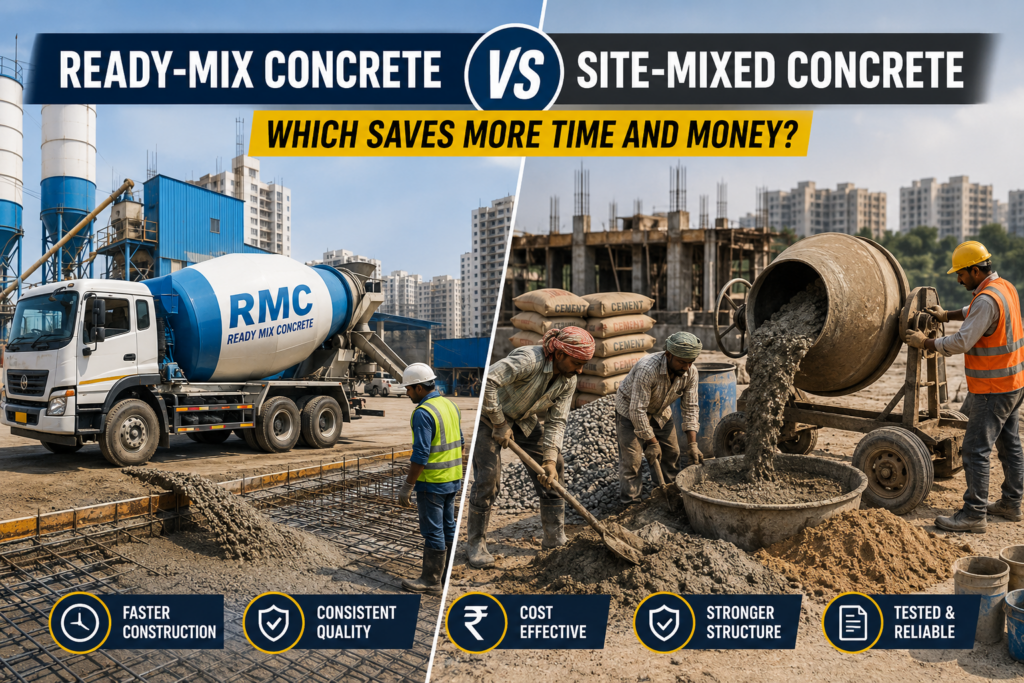
Ready Mix Concrete vs Site-Mixed Concrete: Which Saves More Time and Money?
The concrete in your building’s columns, beams, and roof slabs is not a material you want to get wrong. It is there for the life of the structure, carrying every load the building will ever bear, and its quality at the time of casting determines the structural performance of your home for the next fifty or sixty years.
Yet the decision about how to produce that concrete, whether from a ready mix plant or mixed manually at your site, is one that many homeowners in Bangalore make without fully understanding what the two options actually cost and what they actually deliver. This article gives you the complete comparison.
Understanding the Two Methods
The core difference is not the ingredients, which are the same in both cases, but the precision of the mixing process and the consistency of the result. Ready Mix Concrete uses computerised weigh-batching that controls exact quantities of each component in every batch. Site mixing uses manually measured volumes that vary from batch to batch depending on the workers doing the measuring and mixing.
Ready Mix Concrete in Bangalore: How It Works
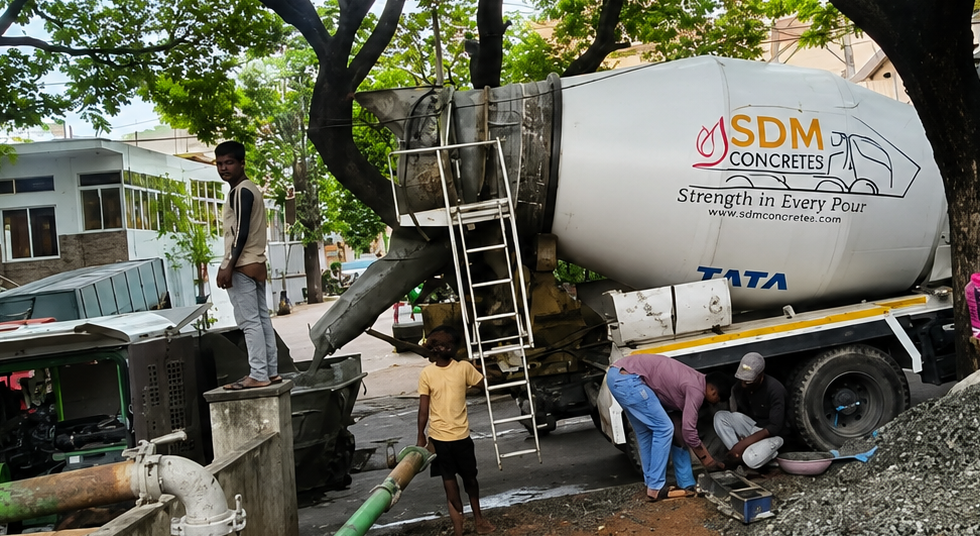
When you order RMC in Bangalore, you specify the concrete grade required (M20 for general RCC work, M25 for standard residential slabs and columns, M30 for heavily loaded commercial structures), the quantity in cubic metres, and the required slump for workability. The plant batches this order in a computerised system, loads it into a transit mixer, and delivers it to your site within a specified time window.
That time window is critical. RMC has a working life of 90 to 120 minutes from the time of batching at the plant to the time it must be placed and vibrated at your site. After this window, initial setting begins and both the workability and the final compressive strength are compromised. This means the ready mix concrete supplier must be located within approximately 30 to 45 minutes of your site under Bangalore’s typical traffic conditions, accounting for the fact that plant-to-site journeys take considerably longer during peak hours.
The concrete is batched to IS 4926:2003 standards and the mix design is certified by the plant. Test cubes are taken at the time of delivery and tested at 7 days and 28 days to verify the concrete achieves its specified compressive strength. These test certificates can be retained as quality records for your building.
Site Mixed Concrete: The Reality
Site mixing has been the standard for residential construction across India for decades and it remains common for small projects. The nominal mix proportions from IS 456:2000 are straightforward: for M20, the ratio is 1 part cement to 1.5 parts sand to 3 parts aggregate. In practice, these ratios are approximations and their accuracy depends entirely on how carefully the site workers are measuring each batch.
The single biggest risk with site-mixed concrete is the water-cement ratio. Water is the variable that workers adjust to get the right consistency for easy pouring. Adding more water makes the concrete easier to work with, easier to pour into tight spaces, and easier to finish. It also reduces the 28-day compressive strength significantly. A 10% increase in the water content of a concrete mix can reduce the final compressive strength by 20% to 30%. This is documented engineering fact, not a theoretical concern. It is one of the most common causes of structural underperformance in self-built homes across Bangalore.
Quality Comparison: What the Numbers Say
Both methods use the same raw materials. The quality difference comes from process control. A computerised batching plant measures cement by weight to the nearest kilogram. A site worker measures by the shovel load or the bucket count. A plant maintains a consistent water-cement ratio by weighing aggregate moisture content and adjusting water addition accordingly. A site mixer adds water until the mix looks right.
RMC test cubes from reputed Bangalore plants consistently achieve or exceed their specified 28-day strength. Site-mixed concrete for the same nominal grade, particularly when the water-cement ratio is not strictly controlled, frequently tests below the specified minimum strength. For structural elements in your home, this gap matters.
Time Efficiency: The Pour Size Factor
For small quantities, a single batch of site-mixed concrete can be produced and poured in a short time without complication. The problem arises with large pours.
A roof slab for a standard 1,200 sqft floor in Bangalore requires approximately 14 to 18 cubic metres of concrete. Two RMC transit mixers, each carrying 6 to 7 cubic metres, can deliver and complete the pour in 3 to 4 hours with a continuous pour that produces a monolithic slab. With site mixing, producing the same quantity using a drum mixer requires hours of batching in sequence, creating unavoidable time gaps between pours. These gaps produce cold joints in the concrete, which are planes of weakness that are structurally inferior to continuously poured concrete. Cold joints in a roof slab are a construction defect that is invisible to the naked eye and impossible to rectify once the slab has cured.
Cost Comparison: The Full Picture
Site-mixed concrete appears cheaper when you look only at material cost per cubic metre. The full cost comparison is more nuanced.
| Cost Item | RMC per m³ | Site-Mixed per m³ | Difference | Notes |
|---|---|---|---|---|
| Material cost | Rs. 4,800 to 5,800 | Rs. 3,800 to 4,500 | RMC higher | Grade M25 |
| Labour for mixing and placing | Included | Rs. 300 to 600 extra | Site-mixed higher | |
| Mixer machine rental | Included in RMC | Rs. 500 to 800 per day | Site-mixed higher | If drum mixer used |
| Concrete wastage | 3% to 5% | 8% to 12% | Site-mixed higher | Manual batching wastes more |
| Pump charges (upper floors) | Rs. 8,000 to 15,000 per visit | Not applicable | Separate for RMC | |
| Effective total (M25) | Rs. 5,400 to 6,400 | Rs. 4,800 to 5,800 | Difference narrows | Including wastage and labour |
Ready Mix Concrete Price in Bangalore (2026)
| Concrete Grade | Typical Application | Price per m³ (2026) |
|---|---|---|
| M20 | General RCC, minor structural work | Rs. 4,500 to Rs. 5,200 |
| M25 | Residential slabs, beams, columns | Rs. 4,800 to Rs. 5,600 |
| M30 | Heavily loaded elements, commercial | Rs. 5,200 to Rs. 6,200 |
| M35 | High-rise structures, pre-stressed | Rs. 5,800 to Rs. 6,800 |
Pump charges are additional and typically range from Rs. 8,000 to Rs. 15,000 per deployment for residential pours. Prices vary based on the supplier’s plant location relative to your site and the order volume. Confirm delivered pricing with your supplier since ready mix concrete prices in Bangalore can vary by 10% to 15% based on distance from the plant.
Finding Ready Mix Concrete Near You in Bangalore
Because of the 90 to 120 minute working window, where you source RMC matters as much as what grade you order. Here is a zone-by-zone guide for finding ready mix concrete suppliers near your site.
North Bangalore (Hebbal, Yelahanka, Devanahalli):
Source from plants along Bellary Road and Tumkur Road. Several established RMC operators serve the Aerospace Park and Devanahalli corridor. Journey times from these plants to North Bangalore sites are generally manageable even during morning peak hours if orders are scheduled for early morning delivery.
East Bangalore (Whitefield, Sarjapur, Marathahalli):
The Outer Ring Road and Sarjapur Road corridor has the highest concentration of RMC plants in Bangalore given the volume of construction in this zone. Multiple suppliers compete here which keeps pricing reasonable and delivery reliability high.
South Bangalore (Electronic City, JP Nagar, Bannerghatta Road):
Suppliers near the Electronic City industrial zone serve South Bangalore sites well. For Bannerghatta Road and Kanakapura Road sites, confirm that the supplier’s plant is below the elevated expressway to avoid transit mixer access complications.
West Bangalore (Rajajinagar, Tumkur Road, Peenya):
The Peenya industrial area has long-established RMC operators. West Bangalore is reasonably well served though peak hour delays on Tumkur Road need to be factored into delivery scheduling.
When evaluating any RMC supplier in Bangalore, confirm their BIS certification under IS 4926, ask for mix design documents for the grades you need, verify their fleet size to ensure delivery reliability during your pour, and clarify their cancellation policy since concrete pours cannot be easily rescheduled once the batch is loaded.
When to Use RMC and When Site Mixing Still Makes Sense
| Use RMC When | Use Site Mixing When |
|---|---|
| Roof slabs, foundation rafts, or any pour above 10 cubic metres | Very small pours under 3 to 5 cubic metres where RMC minimum order is impractical |
| Structural columns and beams where strength consistency is critical | Repair work, pathways, or minor concrete additions |
| Time-critical projects where delays are costly | Sites on very narrow lanes where a transit mixer cannot access |
| Multi-storey buildings with strict quality documentation requirements | Projects in remote locations outside the 45 minute delivery radius |
| Sites in dense residential areas where raw material storage is limited | Small quantities for which RMC pump charges would be disproportionately expensive |
Common Misconceptions About Ready Mix Concrete
Misconception: RMC is always more expensive than site mixing.
When total cost including labour, wastage, equipment rental, and the financial risk of low-strength concrete is factored in, ready mix concrete is often cost-competitive for pours above 10 cubic metres. The upfront rate is higher but effective total cost is frequently similar.
Misconception: Watching site mixing gives you better quality control.
Observation does not equal control. Without calibrated weighing equipment and strict water-cement ratio management, site-mixed concrete quality varies significantly from batch to batch regardless of how closely you watch the process.
SDM Sri Samrudhi operates an in-house concrete batching facility that supplies all our own construction projects. Our concrete is produced to IS 4926 standards with certified mix designs, computerised weigh-batching, and full test cube documentation. We supply ready mix concrete to projects across Bangalore and our team can advise on concrete grades, quantities, and scheduling for your specific project requirements.
Frequently Asked Questions
Our construction experts are here to guide you through every stage of your project, from planning and approvals to construction and final handover.
What is ready mix concrete?
Ready-mix concrete is concrete produced at a central batching plant and delivered to site in a transit mixer, ready to pour. It is batched using computerised weigh systems to a specific mix design and grade, producing consistent quality that manual site mixing cannot replicate.
What is the price of ready mix concrete in Bangalore?
In 2026, ready mix concrete in Bangalore ranges from approximately Rs. 4,500 per cubic metre for M20 to Rs. 6,200 or more for M30. Pump charges of Rs. 8,000 to Rs. 15,000 apply separately depending on the floor level and pour volume.
Is RMC better than site-mixed concrete for home construction?
For any structural element in your home, RMC is superior for quality consistency. The computerised water-cement ratio control in RMC batching cannot be replicated with manual site mixing. For very small quantities or inaccessible sites, site mixing may be necessary but should be supervised carefully.
How much RMC do I need for my roof slab?
Multiply your slab area in square metres by the slab thickness in metres to get the volume in cubic metres. For a 1,200 sqft slab (approximately 111 sqm) at 125mm thickness, you need around 14 to 15 cubic metres plus a 5% to 7% wastage buffer.
How long can RMC stay in the mixer before pouring?
RMC must be placed and vibrated within 90 to 120 minutes of batching at the plant as specified in IS 4926. Beyond this window, the concrete begins to set and both workability and final strength are compromised.
Is RMC available for small quantities?
Most RMC plants in Bangalore have a minimum order of 3 to 5 cubic metres. For quantities below this, site mixing or volumetric concrete mixers are more practical options.
Looking for a Ready Mix Concrete Supplier in Bangalore?
We supply RMC with certified mix designs and test cube documentation, helping you pick the right grade and quantity for your pour. Get a ready mix concrete price estimate now!